
Home » Geocell
Geocells are three-dimensional networks of welded polymer strips that, when expanded and filled with granular materials (such as soil, sand, low-grade concrete, or gravel), form a “honeycomb cell” structure. These cells create lateral confinement (hoop stress), preventing the sliding and lateral deformation of the granules, significantly increasing the stiffness and load-bearing capacity of the layer. The result is reduced settlement, decreased thickness of the base/sub-base layer, and improved stability of slopes and channels.
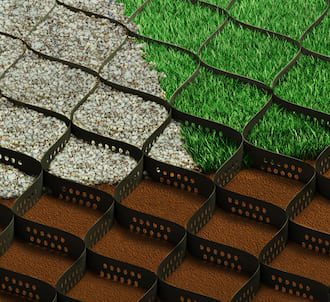
Increased load-bearing capacity and reduced permanent settlement in pavements and surfaces under repeated loading. Laboratory and field tests have reported reduced deformation and improved Traffic Benefit Ratio (TBR).
Reduced thickness of granular layers, leading to lower material transport and installation costs, along with improved construction cycles. Research reports and design guidelines have been based on this effect.
Erosion control and slope stability: Cells calm surface flow and prevent slope surface sliding; steep slopes can be filled with vegetative cover, stone, or concrete.
Protection of channel/coastal beds against hydraulic shear and scour.
Retaining walls and trenches: Construction of modular gravity walls with local fill, without prestressing forces.
Stability on weak subgrades (peat, soft clay, settlement-prone areas) by stress distribution and preventing punching failure.
Geocell Applications
Roads and runways/industrial parking: Strengthening base and sub-base layers for heavy traffic and repeated loads.
Mining and logistics: Mine haul roads, truck yards, ramps.
Slopes and road/railway embankments, ramp lining: With vegetative or stone fill.
Channels, culverts, and dam toes/stilling basins: Reducing flow velocity and protecting against scour.
Modular gravity retaining walls and riverbank/coastal margins.
Geocell Material Selection: HDPE vs. New Engineering Polymers
HDPE (High-Density Polyethylene): The most common material for civil engineering geocells; its main advantages are chemical stability, flexibility, and extensive track record.
NPA (Novel Polymer Alloy like Neoloy): Laboratory research indicates that higher modulus strips can increase bed stiffness and reduce settlement, especially at high temperatures/long-term conditions (better creep behavior than HDPE reported). Note: These findings are primarily published by the manufacturer/research collaborators and should be supplemented with engineering judgment and independent sources.
PET/Composite Polymers: Some recent studies have compared the behavior of HDPE, PET, and blended polymers; conclusions depend on geometry, fill type, and loading conditions, with no absolute “best” option.
Key Parameters in Geocell Specifications
Cell Height (e.g., 75–200 mm): Higher height → greater lateral confinement and stiffness, suitable for heavy loads/weak subgrades.
Cell Dimensions (Aperture) and Strip Thickness/Width: Smaller cells for fine-grained materials and scour control; thicker strips → greater durability and weld strength.
Strip Surface (Smooth/Textured/Perforated): For better mechanical interlocking with fill material.
Weld Quality and Connection Strength: Determines the panel’s tensile capacity during deployment and operation.
Chemical/UV Compatibility and Creep Behavior: At project operating temperatures.
Subgrade Preparation: Leveling, removing weak spots, and using geotextile separators if needed.
Panel Deployment and Edge Anchoring: Use stakes, anchors, or ropes/tendons on steep slopes.
Filling: From top to bottom (on slopes) or from one corner (horizontal surfaces) with layer-by-layer compaction.
Strictly Follow Manufacturer’s Guidelines: (Videos/reliable guides are available).
Comparison and Proposed Product Arrangement for “Khanjani Polymer Industries”
Based on the common geosynthetic product range in Iran, geocells can be offered/supplied in three categories. If the company’s actual product range differs, this matrix can be reconfigured based on your inventory.
| Product Grade | Material and Key Features | Recommended Applications |
|---|---|---|
| KJ-GCL-H | HDPE with 100–150 mm height, textured/perforated surface | Light to medium pavement, parking lots, access roads, green slopes |
| KJ-GCL-H-Plus | Heavy-duty HDPE with 150–200 mm height and thicker strips | Mining/heavy logistics, very weak subgrades, heavy channels |
| KJ-GCL-E (Engineering Grade) | Engineering polymer (NPA or PET as per order) | High temperatures/long-term durability, maximum settlement reduction |
Parking Lots and Industrial Yards on Medium Subgrade: KJ-GCL-H, 100–150 mm height, medium cell, washed sand fill.
Mining Haul Roads/Heavy Truck Yards on Soft Clay: KJ-GCL-H-Plus, 150–200 mm height + geotextile separator.
Green Slope Landscaping with Erosion Control: KJ-GCL-H with smaller cells and vegetative soil/seeding fill.
Channels with High Shear or High Temperatures: KJ-GCL-E with stone/concrete fill.
Standards and Technical Resources for Design
FHWA guidelines and geosynthetic educational texts for design/implementation (material selection, performance mechanisms, quality control).
University/Department of Transportation research reports on geocell-reinforced pavement design, numerical modeling, and lifecycle cost analysis.
Reliable manufacturer guides (as supplementary references for implementation details, height/cell selection, and anchoring details).
Implementation Summary for “Khanjani Polymer Industries”
Geocells are a cost-effective and quick-to-implement tool for increasing load-bearing capacity, controlling erosion, and stabilizing slopes/channels.
To complete the product portfolio, it is recommended to offer three categories: standard HDPE, heavy HDPE, and engineering-grade (NPA/PET) to cover a wide range of projects; emphasis on weld quality control, strip thickness, and supplier testing is critical.
For projects with high repeated loads/high temperatures, an economic and technical evaluation of using higher-modulus engineering polymers is recommended (relying on independent data alongside manufacturer documentation).

ارتباط با مشاورین ما
👋نیاز به راهنمایی دارید؟
کارشناسان صنایع پلیمری خانجانی آماده پاسخگویی به سوالات شما هستند.